
Triggered
Outward and Audible (and Visual) Realities

Triggered
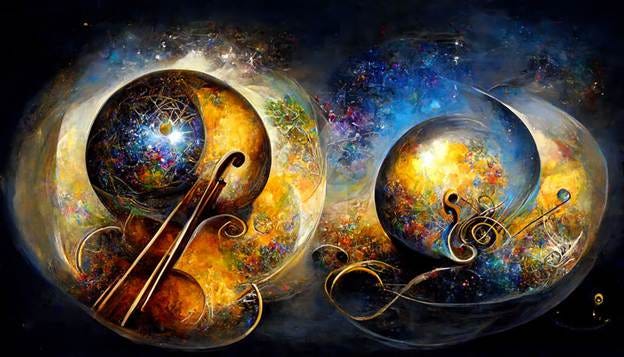
As I write it is a day of unending light rain. I awoke to no internet access, itself an annoyance compounded by more than an hour of telephone contact with the provider resulting only in a promise of a service call five days from now. But the isolation from news has had its blessings, including spending more time in daylight with a book, and in listening to recorded music.
Perhaps in token of the day my focus has been on abstract music, not programmatic. I have listened to all twenty-four of the Preludes and Fugues for piano, Op. 87, of Dmitri Shostakovich, performed by the inimitable Konstantin Scherbakov. I am familiar with the work from at least four other performances. The original promoter of the cycle (which unlike J. S. Bach’s Well Tempered Clavier, which progresses through semi-tones, follows the model of Frédéric Chopin’s 24 Preludes, a circle of fifths) was Tatiana Nikolaeva. I find her tempi slower than I prefer. The same can be said of Keith Jarrett, jazz genius who can be heard humming. I well remember a recording of a selection of the piece performed by Shostakovich himself. He proved to be quite a pianist. But my reference performance was a 1970’s LP release on RCA Victor featuring the rarely heard Australian pianist Roger Woodward. Scherbakov gets very, very close to my own biases.
I was introduced to this music by my older brother, who came home one day when I was a freshman in high school and put the Shostakovich recording (one of the cut-price HMV reissues labeled in the U.S. as Seraphim—“Angels of the Highest Order”) which he had purchased in the dollar bin at the record store. I was smitten from the get-go. (My brother had unerring taste, particularly in Russian music new to both of us. I cannot listen to Borodin’s In the Steppes of Central Asia without thinking of him and misting up, to the point of having to pull off of the road when the piece came over the car radio.
I expect to be affected listening to the Shostakovich. What I did not expect was to be reduced to blubbering at the diaphanous fugue primarily in the upper register of the piano that completes the no. 7 Prelude and Fugue, in A major. It is a piece I remember well from the Shostakovich LP. But why the trigger now? Why the trigger amidst part of my brain searching to identify the piano? (The piano is unidentified in the recording notes, but I would bet money on a Steinway, both for the signature of the upper register and for the simple fact that Steinway has released some of Scherbakov’s recordings.)
Shostakovich turned to abstract music at a time (following the 1948 Zhdanov Decree) when his bona fides as a Soviet composer was questioned. He found it difficult to have music performed, and survived financially only by means of film scores which were generally both anonymous and sufficiently imbued with Soviet Realism. His “serious” works of the these years tend, therefore, to be introspective. The preludes and fugues follow a relative thaw which allowed him to travel to Leipzig for an important Bach festival in 1950. There, his being drafted as performer for a Bach keyboard concerto for three pianos—together with his encounters with Tatiana Nikolaeva—resulted in his focus on music theory as embodied in specific compositions.
A simple explanation for my being moved to tears by the music would be the association of the fugue with an otherwise-unremembered moment with my brother in first encountering it. That’s the most likely explanation, one coupled with the experience of his loss being made fresher by what was shared in the discovery of the piece. But I am haunted by the possibility of a less simple explanation. I could claim to be a “sensitive guy”, and go on about the particular music of that particular fugue, but this would do little to explain a similar reaction I had to the fugue no. 24, in D Minor, a monumental piece of music that is the opposite of diaphanous. No, there’s something more, something in the “math” of the music, in the formal structure of harmonies and rhythm, of key signatures and melodies.
During the Baroque era it was formally argued that the “something more” could be explained by the effects of outward and visible (or audible) signs of such a thing as passion upon the bodily humors. Such arguments fall under the Doctrine of Affections and were notable in French theory (styled by twentieth century German critics as Affektenlehre). These arguments paralleled, but were more extensive than, those offered by literary critics who referred to “pathetic compositions”. No less than René Descartes elaborated six basic affects: Admiration, Love, Hatred, Desire, Joy and Sorrow. These could be combined into numerous intermediates, all under a system described in detail by the German composer and theorist, Johann Matheson (1681—1764). Matheson argued, for example, that large musical intervals could be used to both express and evoke joy, because joy represented an expansion of the soul. The German school of thought fully developed by Matheson is sometimes referred to as musica poetica.
Speculations about affections and humors seem quite quaint—or at least pre-scientific—but the next time you listen to Tchaikovsky’s Symphony No. 6, in B Minor, styled in the West Pathétique and in Russian as the Патетическая (Pateticheskaya or “Passionate” or “Emotional”), ask yourself if there’s something in the music that corresponds to the description. (The cognomen of the symphony was suggested to the composer by his brother, Modest.) Certainly, the symphony ending with a slow movement, and in a minor key, is unusual. Certain critics have even argued that the symphony was a “suicide note”. Tchaikovsky did die (from cholera) nine days after the premiere, and from his death there have been rumors and arguments that the composer deliberately drank contaminated water in order to avoid a Court of Honor summons to answer charges relating to his homosexuality.
Perhaps the Pathétique is a special case. Perhaps I should not be surprised to react emotionally to a piano piece I associate closely with one dear to me whom I have lost. But, can we just dismiss the idea of Affections? The reference to the effect of music on bodily humors can be understood as dated, at best, and yet if we substitute terms like “neurotransmitters” and “neuroreceptors” for humors we face the question of how something external can change neurochemistry. In exploring this question I am struck by the language used by the French, that the effects were caused by “outward and visible (or audible) signs”. I am struck by this because of how we define a Sacrament in the Church as “an outward and visible sign of an inward and spiritual reality”.
It would be tempting to parse this language in terms of neurochemistry, and a similar argument has indeed been made by those who argue that “God” (their scare quotation marks) is a construct in evolutionary biology, a brain adaptation to allow humans—who enjoy a different level of cognitive self-awareness that includes an awareness that we will die—to function despite fear. (See, e.g., The “God” Part of the Brain: A Scientific Interpretation of Human Spirituality and God, by Matthew Alper, 2008.) The problem of such arguments is one of causation. The “scientific interpretation” focuses on mechanism. It does not consider that the mechanism has a cause, and that if even one substitutes “Evolution” for “God”, a material cause has not been identified, and the explanation does not exclude the reality that an all-powerful God could use the mechanism of natural selection to further His purpose that the human He created should bear His “image and likeness” (Gen. 1.26), i.e., an element of spirit and spiritual response. The argument becomes, in effect, circular.
As a Christian priest I do not, of course, reject the realm of the spiritual. The Affects of French musical theory begin, then, to look to me more like how certain eternal and objective realities affect our being. This is not to agree with the classifications of Descartes or Matheson. But if we return to the famous quotation from 1 Corinthians 13, “For now we see in a mirror dimly, but then face to face. Now I know in part; then I shall understand fully ...” (1 Cor. 13.12), it becomes more evident that we are affected by something like music because in certain intervals, in certain tones and rythms, in harmonies and melodies, we receive an audible hint of what is eternal in tone and rythm, in harmony and melody. We do this when we behold visual beauty and gasp, having received a brief glimpse of the source and summation of all beauty. Our inward and spiritual being is affected by an outward and audible or outward and visible reality.
The next time you shiver or mist up in response to something outside of you, whether this be musical or in the visual arts, if the trigger is a memory of a loved one or loved place, give thanks and offer a prayer. If the trigger is unknown to you, give thanks for those eternal realities that we may capitalize and Beauty, Truth, Good, Love. Give thanks for these always in offering thanks to their source and summation.